


Staying Current With DME Enrollment Requirements
-

In last week’s column, we discussed several common DME enrollment issues. Two groups of suppliers were identified as being at high risk for revocation. The first group includes providers who complete the enrollment or revalidation process themselves without sufficient expertise. The second group includes suppliers who fail to notify their enrollment carriers when important updates occur within their practice profile.
Last week’s article suggested working with an experienced enrollment specialist to help avoid mistakes during the application process. This week, we will focus on the second group’s issue: maintaining current enrollment information.
How do you know when Medicare must be notified of a change to your enrollment, even if your enrollment was successfully renewed within the past three years for DME suppliers, or every five years for your local Medicare carrier?
The answer is straightforward. Any changes involving your licensure, insurance coverage, or the types of products you dispense may require updates to your enrollment profile.
Changes in licensure information are not always automatically transmitted to your enrollment carrier. However, enrollment carriers routinely conduct internal audits of provider records. If they discover that the license submitted with your last enrollment has expired, your PTAN may be terminated and your supplier privileges revoked.
For DME suppliers, the same applies to your general liability and property insurance. Your enrollment carrier must be listed as the Certificate Holder on your insurance policy. This means that if your insurance policy is canceled or terminated, the carrier will be notified. If there is no replacement policy on file, your enrollment may be terminated as well.
Rather than relying solely on your new insurance carrier to submit updated certificates, providers should take the initiative and submit updated documentation themselves. It is equally important to avoid any gaps in coverage, as even a temporary lapse can constitute a Supplier Standard violation and potentially result in revocation.
Expanding the types of services or products your practice provides may also require an enrollment update. For example, adding lymphedema compression garments, osteogenesis bone stimulators, or advanced biomechanical technologies such as pressure-mapping systems and digital gait analysis solutions may warrant a modification to your enrollment profile. Even what may seem like a routine transition, such as moving from dispensing off-the-shelf AFOs (e.g., CAM walkers) to providing custom-fitted or custom-fabricated Root orthotics and AFO solutions, requires an enrollment modification.
Local Medicare Administrative Contractors are also increasingly monitoring provider enrollment information. As part of CMS’s ongoing efforts to combat fraud, contractors are reviewing licensure status and malpractice insurance expiration dates more aggressively than in the past. It is in every physician’s best interest to ensure that all critical information remains accurate and current.
Summary
Recent government initiatives aimed at reducing Medicare fraud have resulted in increased scrutiny of provider enrollment by both local Medicare contractors and DME carriers. Private insurance carriers are also likely to adopt similar strict standards in the near future.
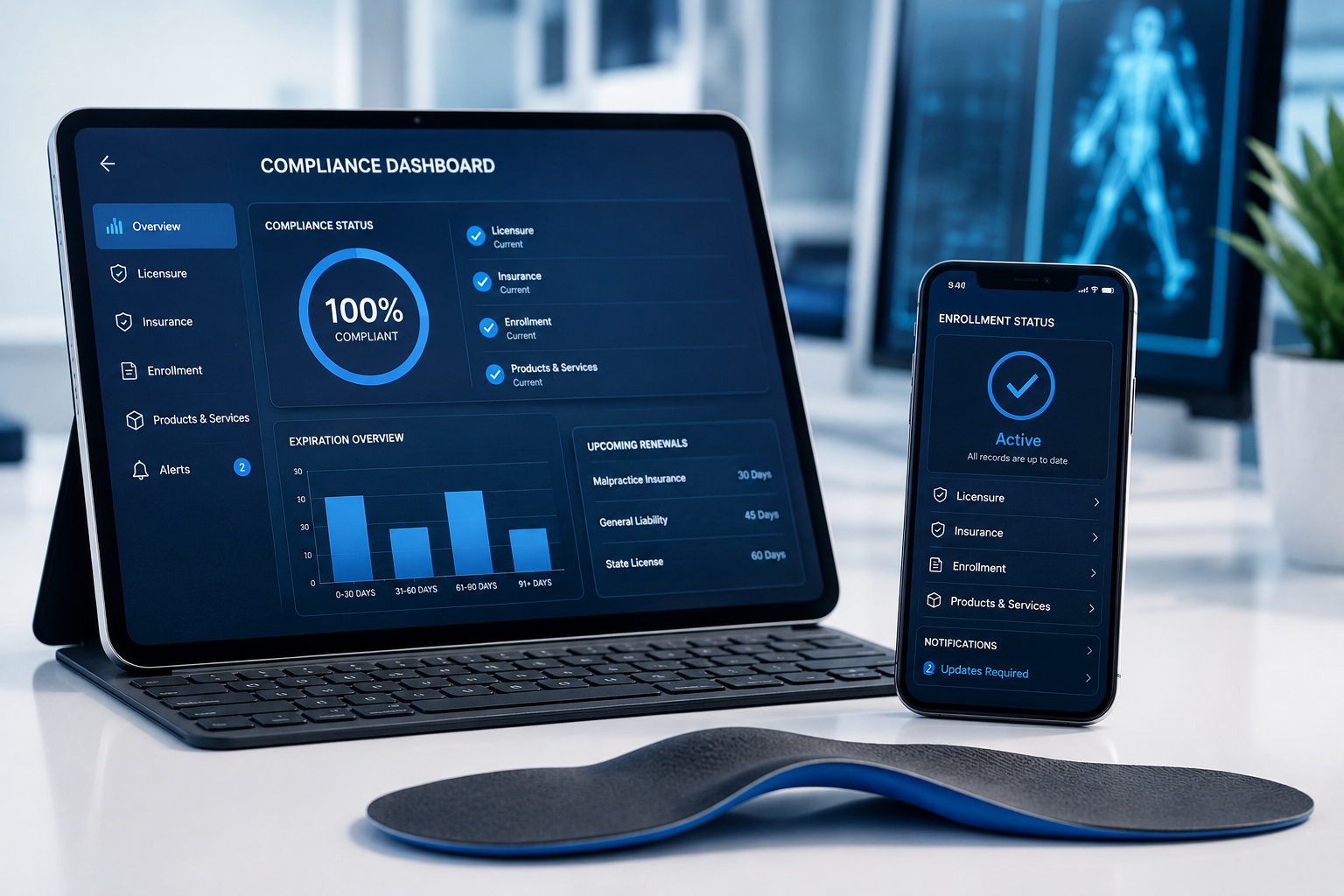
Maintaining an organized compliance program to track licensure, insurance renewals, and enrollment updates is no longer optional. It is an essential part of your practice’s compliance program. This information should be reviewed regularly to protect the financial security and operational stability of your practice. Incorporating the practices provided in the past two weeks’ columns into a regular routine can help ensure your practice’s long-term financial success.
KevinRoot Medical is available to help connect you with experienced professionals who can assist with all of your enrollment needs, while also supporting practices with premium Root orthotics, custom AFO solutions, and advanced lower-extremity biomechanical technologies designed for today’s modern podiatric practice.
