


K Modifier
-

This week’s column answers a question from a reader:
"I recently billed for a L5020 Tibial tuberosity toe filler. Despite obtaining pre-authorization from the carrier, the claim was rejected for lack of a “K” modifier? What is that?"
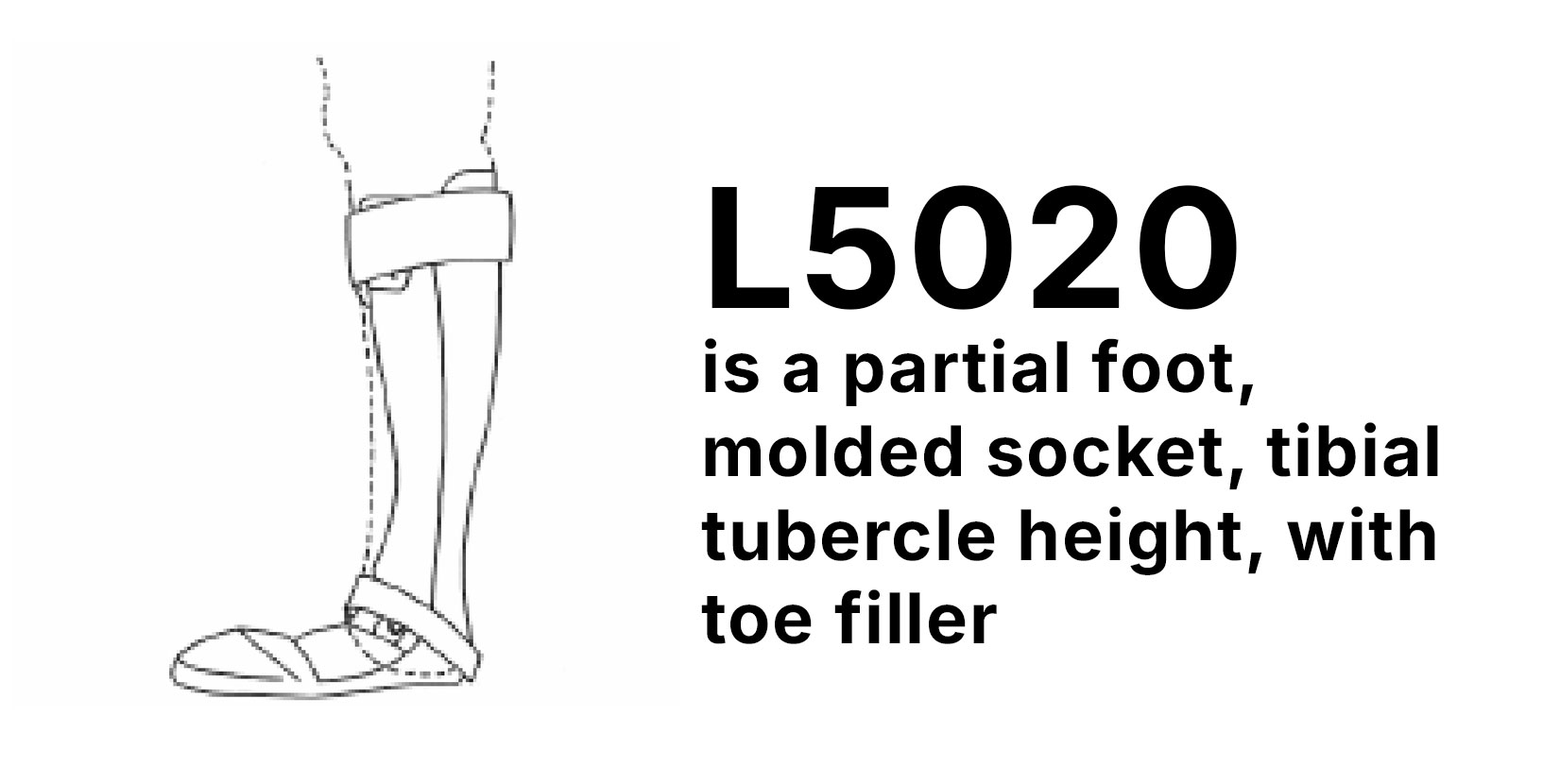
This device can simply be thought of as a custom fabricated AFO which extends proximally to the tibial tubercle and distally incorporates a toe filler (as would be typical of an L5000). But HCPCS prefers the one code of L5020, which is located in the lower limb prosthesis LCD, as opposed to using a combination of an AFO and prosthetic code L5000.
The Policy Article attached to the Lower Limb Prosthetic Carrier Decision (LCD) mandates that “K” modifiers, which simply define the patients ambulation capacity (functional level) be used when billing certain prosthetic devices. For Fee for Service Medicare, none of the lower limb prosthetic devices typically prescribed or provided by podiatrists require the “K” modifiers. However, Medicare Advantage and other third-party carriers are free to implement those billing requirements.
It would be expected that your chart documentation would have specified the ambulatory functional level of your patient. Without such descriptions, it would be hard to understand how the carrier provided prior authorization.
Below one can find the “K” modifiers as they apply to patients needing a lower extremity prosthetic and the buzz words (in bold) which should be documented in your chart:
K1: Patients with the ability or potential to use a prosthesis for transfers or level-surface ambulation at a fixed cadence. (Household ambulator).
K2: Patients able to traverse low-level environmental barriers like curbs, stairs, or uneven surfaces (limited community ambulator).
K3: Patients with the ability to ambulate with variable cadence and traverse most environmental barriers (Community ambulator).
K4: Patients who exceed basic ambulation skills, exhibiting high impact, stress, or prosthetic demand typical of child, active adult, or athlete athletes.
K0: Patients who does not have the ability or potential to ambulate or transfer safely, and a prosthesis does not improve their quality of life.
As noted the chart documentation must contain descriptions of what the patient can or cannot due. One common example: The patient can or will be able to traverse sidewalk curbs, uneven surfaces at variable speeds, but cannot/will not run. (this best describes a K3 patient).
Think of the modifier as the way the bill will communicate to the third party the patient’s functional abilities.
Typically Medicare will not cover patients who are K0. Additionally, the higher up the K# you go, the more likely Medicare and other carriers are likely to cover sophisticated materials and electronic modified prosthetics. The latter are typically not included in L5000-L5030.
To summarize, the K# modifiers are used when billing your third party carrier to advise them of the patient’s functional abilities. Those should be well documented in the patient’s chart. If prior authorization is required, the objective findings and buzz words noted above should be well documented.
For all your billing inquiries, please feel free to contact your KevinRoot Medical support team for answers to many of your billing issues.
