


Orthotic Device for Stage 3 or 4 PTTD
-

Custom made functional foot orthotic devices can be used both pre-op, post -op, or to conservatively manage permanently patients in Stage 3 or Stage 4 PTTD or Adult Acquired Flat Foot.

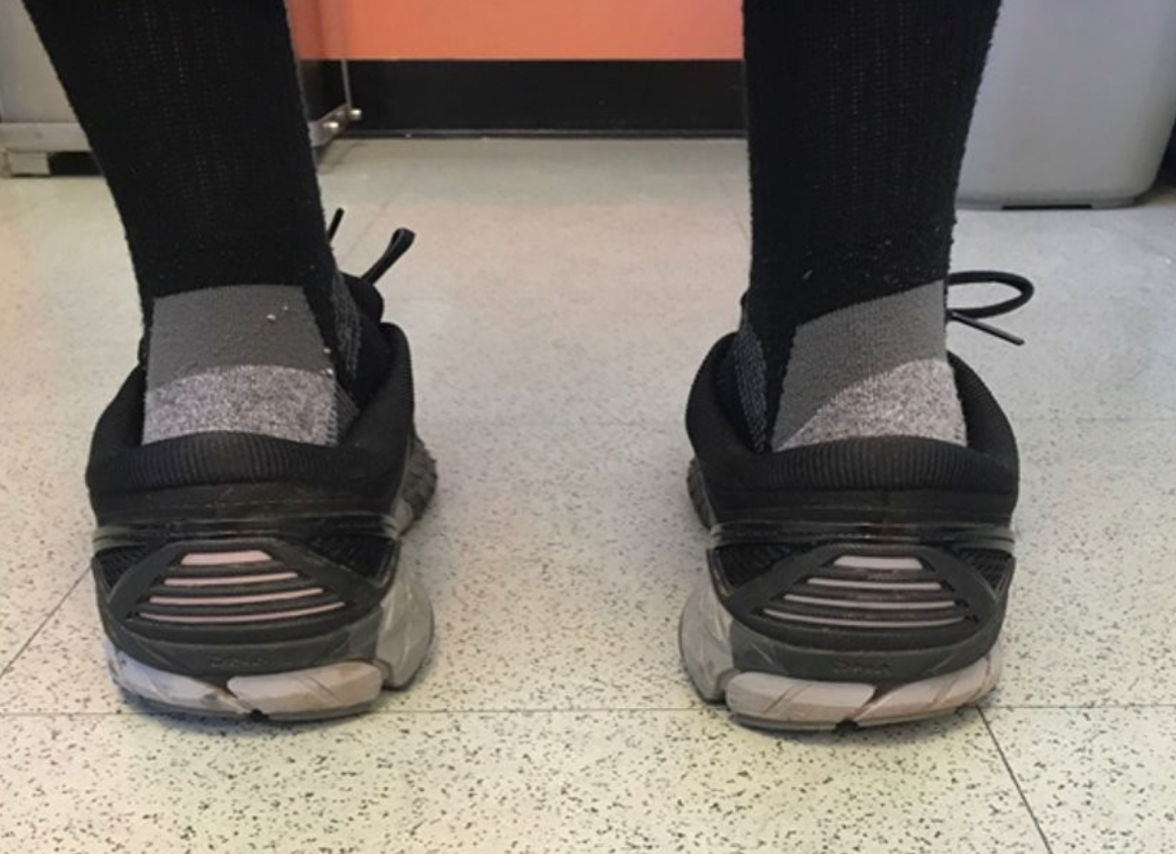
Same Patient with Pronation Help including Brooks Beast Shoe
What prescription did I write for this kind of correction?
This requires a gradual approach. The 17 degree everted needed 3 orthotic devices to obtain close to heel verticality (which was my goal), and the 14 degree everted needed 2 orthotic devices. The inverted Rx starts at 35 degrees which will invert the RCSP 7 degrees on average. Since the RCSP is easy to measure, I will always measure it with and without the orthotic devices to see the change created. And, of course, this is then correlated to what we see in gait. The patient was instantly more stable, and I had him still very far from vertical. On another post, I will go over how to obtain verticality (which was subtalar joint neutral in this case I believe). He had no inversion past a verticality of the achilles angle (tibial calcaneal angle), but at least he could supinate to here. The Brooks Beast shoes were crucial at gaining me 3 more degrees, and I placed 4 more degrees of varus posting on the original orthotic device on a subsequent visit. The original Rx therefore was 35 degrees inverted (some will start at 25 degrees and add a medial Kirby skive, or will direct Root Balance 5-7 degrees inverted with the Kirby Skive). I can not tell you which is a better device, but all get the patient moving in the right direction. You have to have a 25 degree medial and lateral heel cup. You have to flat post to zero degrees (no motion coming from the post). I use 3/16 inch poly and make the device as wide as the foot and shoe allows. For the left only, I needed a sweet spot for the bony prominence under the navicular. This is placed right into the device, and I also use poron to make further accommodations on subsequent visits.
