


Deep Dive into Inverted Orthotic Devices (to start the New Year 2026)
-

I have had the pleasure and privilege of working with great minds in the attempt to understand why my Inverted Orthotic Technique works so well. I have also had my immense frustrations at its general misunderstanding and sometimes laboratory poor quality (which turns doctors away from trying). I read with great fun this article from the United Arab Emirates in 2023. I will try to summarize it for you, and make my own observations.
- In 31 females with RCSP of 4 or more everted degrees, and flat feet, the study tested the mechanics of shoes alone, a properly made 15 degree inverted orthosis, and a properly made 25 degree inverted orthosis.
- The Results: compared to the shoes only condition, both the 15° and 25° inverted orthotic conditions significantly decreased the maximum ankle plantarflexion angle during loading response, maximum ankle dorsiflexion angle during mid-stance, maximum ankle external rotation angle, and maximum ankle internal rotation angle. The maximum ankle plantar flexion angle at toe-off showed a significant decrease with the 25° inverted angle orthosis compared to both the 15° inverted angle and shoes only conditions. No significant differences were found in the knee kinematic variables, maximum hip extension angle, and maximum hip adduction angle between test conditions.
What does it mean?
- First of all, the inverted orthotic device makes functional changes.
- Patients landed in a more stable position with decreased maximum ankle plantar flexion angle
- Patients did not flatten their arches as much so a decrease in midstance maximum ankle dorsiflexion
- The patients stayed centered better in the transverse plane with both a decrease in ankle internal and external rotations
- Only the 25 degree inverted orthotic showed some decrease in push off (or maximal ankle plantar flexion at toe off) which was disappointing leading the authors to recommend the more predictable 15 degree inverted device in general.
- Moreover, the maximum hip external rotation angle significantly increased (p < 0.001) in both orthotic conditions compared to the shoes only condition, although no significant changes were observed between the two orthotic conditions with different inverted angles. This is totally expected and desired as when you invert the foot you will cause an external moment or rotatory force up the leg to the hip.
- Other studies have agreed with them that the inverted orthotic device did not put any abnormal stress on the hips and knees.
Here is an image of their devices which look appropriate for the technique
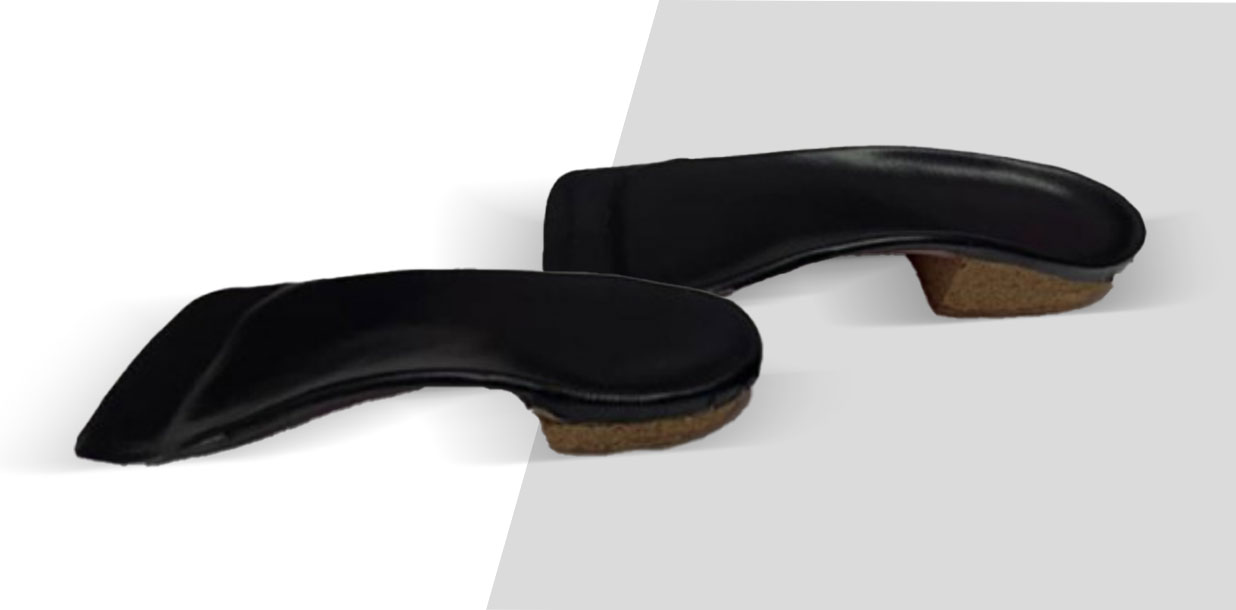
My own comments briefly concern an explanation of why the 15 degree inverted orthotic increased push off and the 25 degree did not. When you take an unstable flat foot and add stability, couldn’t you see in these patients that were just walking a desire to hold onto that stability as long as possible. We know shortening strides with less heel strike pattern is a way of gaining stability. This may decrease ankle plantar flexion in the contact phase (considered biomechanically good), but also decrease ankle plantar flexion in the propulsive phase (presently considered bad). Food for thought? In this study, they did not look at changes in stride length between the three conditions.
There was no break in to these devices to speak of. Dr. Joseph D’Amico at the New York College of Podiatric Medicine will not do computer assisted gait analysis for 2 weeks after the dispensing of an orthotic device. He says the patients need to adapt neuromuscularly. In his eyes, The patient should be given 2 weeks with each orthotic device before the 3D computer analysis was done. He definitely has found that the orthotic devices behave better with this adjustment period.
The last point is that the authors made no effort to have the patient in stable shoes which they thought would add another variable. However, since each patient used their own shoes, in various states of being worn, that is more of a variable than from the start getting the patients into new stable shoes (and yes, another 2 week break in).
In summary, the Inverted Technique has been around for over 40 years now, with still a large misconception of the technique in Podiatry. KevinRoot Medical makes these 15 and 25 degree Inverted devices for your patients. As I am big on functional change with what I prescribe, this works well for your pronators that need more support. You can even get creative and add medial Kirby Skives, ff and rf varus posting, medial flanges, etc to your inverted base. I hope you will try these also in your running orthotic devices also, as the foot pronation with running is so much more than mere walking.
