


Patients Status Post TMA: Addressing More Advanced Biomechanical Needs
-

The first installment addressing the biomechanical needs of patients’ status post trans metatarsal amputation (TMA) reviewed the major biomechanical challenges these patients face and initial treatment approaches utilizing toe fillers and shank additions. This second column addresses treatment options for patients requiring more proximal control and support.
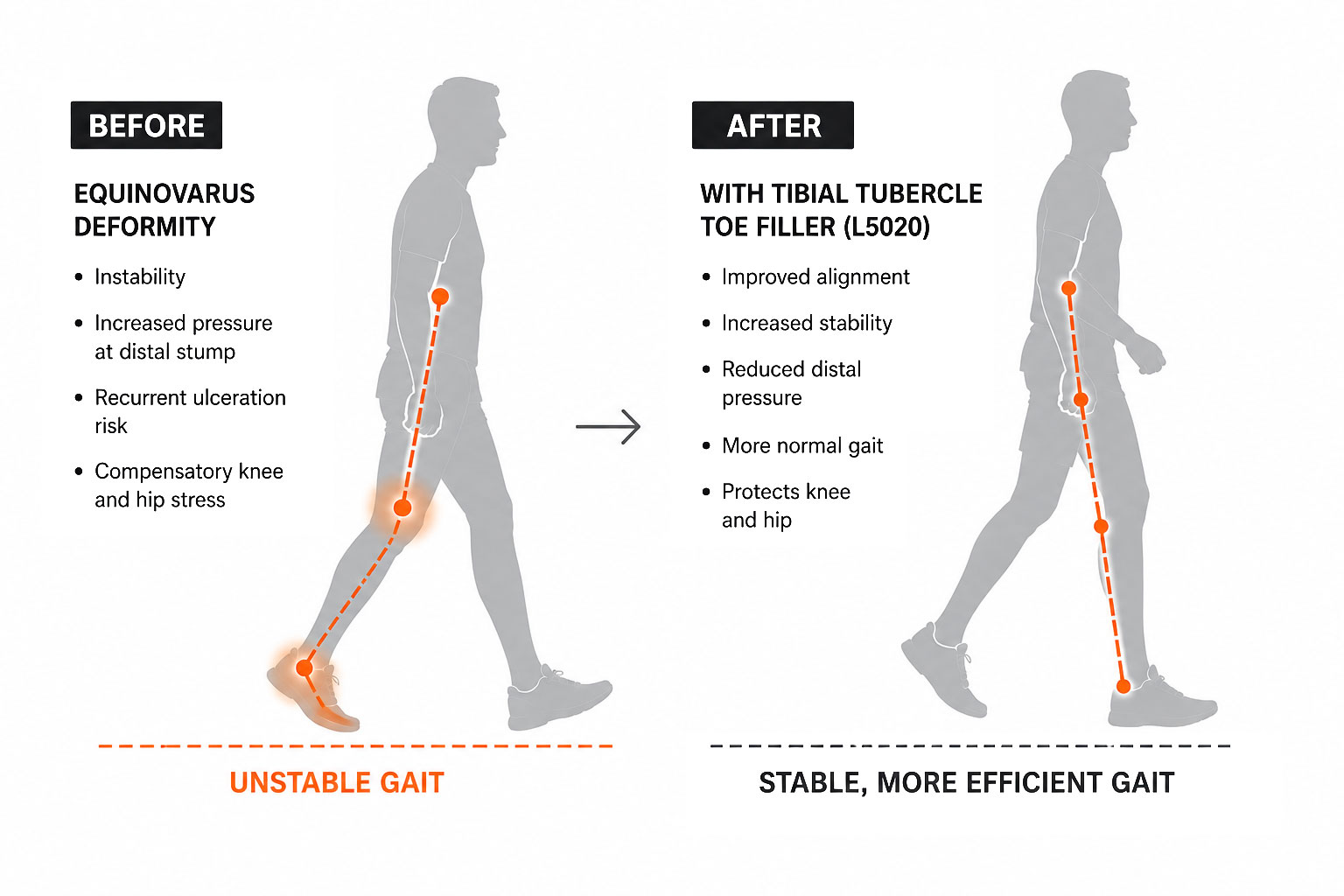
Many patients following a total TMA develop significant equinovarus deformities. For these patients, a simple toe filler (L5000) or a toe filler with rigid carbon reinforcement (L5000 + L2755) is often insufficient to address more advanced biomechanical deficits.
Left unchecked, these patients frequently develop recurrent ulcerations resulting from increased plantar pressures at the distal stump, particularly at the fifth metatarsal base. Others may develop or accelerate knee and hip pathology as these proximal joints attempt to compensate for the equinovarus deformity.
A toe filler with rigid uprights extending well above the ankle joint, can help restore a more normal gait pattern by providing increased mechanical support and preventing shoe buckling. As noted in the prior article, these devices can also store energy and assist forward propulsion during the later stages of gait.
For most adult patients, supramalleolar (SMO) prosthetic devices (L5010) often do not provide sufficient corrective forces because of the limited height and lever arm of the SMO design which extends just superior to the ankle joint. However, a toe filler extending proximally to the tibial tubercle (L5020), with appropriate modifications, can provide adequate corrective forces for many patients with substantial equinovarus deformities and facilitate a more normal gait pattern.
The rigid uprights of a tibial tubercle toe filler function as a lever arm, improving stability and helping maintain the foot in a more neutral position depending upon positioning during casting. These uprights may be fabricated from polypropylene, which is standard, or carbon fiber, which is lighter, provides more efficient energy return, and may be especially advantageous for heavier or more active patients.
Similar to a simple toe filler, the footplate portion of the prosthesis is designed to reduce foot slippage and prevent shoe buckling, thereby reducing pressure at the stump and contributing to a more normal gait pattern.
Varus/valgus straps (L2270) may be strategically positioned on the footplate and circumferentially around the uprights to secure the foot and lower leg within the device while maintaining a neutral alignment.
Some patients may additionally require a varus/valgus plastic modification to the upright or footplate, which can be added and coded as L2275.
As discussed in the prior article, documentation should extend beyond merely listing physical findings and diagnoses. Clinical records should specifically describe how the prescribed device is expected to improve function and, at the time of dispensing, document objective findings supporting improvements in gait and function.
Patients receiving either a simple toe filler (L5000) or a more advanced L5020 device often require multiple fitting visits. Many adjustments can be performed in the office using common tools including a Dremel tool with sanding disks or grinding attachments, a heat gun, and a retractable utility knife.
Patients fitted with L5020 tibial tubercle–height prosthetic devices may also benefit from rehabilitation services to facilitate training and adaptation to these devices. Relevant CPT codes may include:
- 97750 – Functional Capacity Evaluation
- 97761 – Prosthetic training, initial encounter
- 97763 – Prosthetic management and training, subsequent encounter
Codes 97761 and 97763 are billed in 15-minute increments with the time treatment initiated and finished clearly documented.
Providers should review their local MAC or third-party payer policies, including applicable physical therapy LCDs and fee schedules, for additional coverage and reimbursement guidance.
KevinRoot Medical is available to help connect you with experienced professionals who can assist with all of your enrollment needs, while also supporting practices with premium Root orthotics, custom solutions, and advanced lower-extremity biomechanical technologies designed for today’s modern podiatric practice.
Disclaimer: CPT codes are copyrighted by the AMA, all rights reserved. HCPCS codes are the property of CMS.
