
When Treating Patients, Is More Always Better?
-

I hope you all get to read the excellent article by Kevin Rosenbloom, KRM owner, on 25 clinical pearls for a biomechanical practice. One of the pearls that I am highlighting today is that more is not always better in the world of corrections of biomechanical faults. Many times you just need to move them in the right direction with some pronation support when needed, or other problems like supination issues and limb length issues. This directional change in a pronated pes planus patient may be partially achieved with some inversion from an orthosis accompanied with stability shoes and strengthening work for example. Each of these 3 components can add to a great improvement in the patient’s stability and comfort.
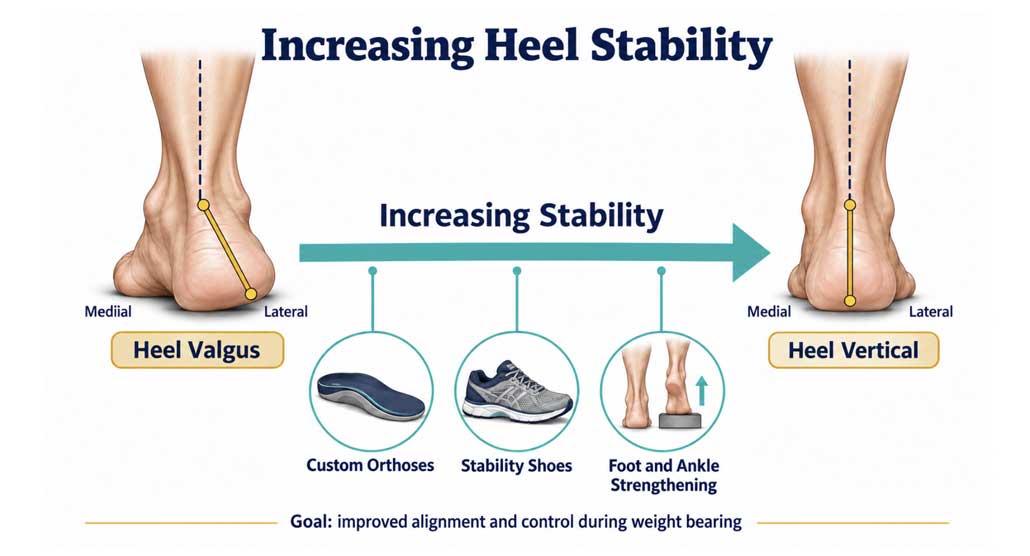
One of the concepts here is that the shoes and orthoses are both very important in this process of stabilization. When add in a good foot and ankle strengthening program, typically including metatarsal doming, posterior tibial and peroneus longus resistance work, and single and double heel raises, the foot gets so much more stable. Of course, orthotic devices and shoes are relatively quick solutions while the exercises can take months of work.
The article presented here compares 2 common corrections using the Inverted Orthotic Technique emphasizing that the lower correction may be better. A Korean doctor, Dr Jinwook Song, who treats hundreds of pes planus children says he typically starts at 25 degrees and only goes higher if symptoms warrant (as their heel valgus by itself would always warrant). I have attached my student handout of conclusions for your perusal.
INVERTED FOOT ORTHOSES: 15° vs 25°
Student Teaching Handout • Flexible Flatfoot • Blake Inverted Orthotic Technique
THE CLINICAL QUESTION
Does stepping up an inverted orthosis from 15° to 25° yield notably greater shifts in walking mechanics for young adults dealing with flexible flatfeet?
Study at a Glance
Participants
31 women, aged 18–35, presenting flexible flatfoot deformity (RCSP ≥ 4° valgus in at least one foot).Design
Randomized crossover trial where each subject walked across all 3 conditions.Conditions
Standard shoes alone vs 15° inverted devices vs 25° inverted devices.Orthosis
Rigid orthoses fabricated via the Blake Inverted Orthotic Technique.Outcome
Immediate 3-D lower-extremity gait kinematics.WHAT THE STUDY FOUND
Finding
15°
25°
Student interpretationMost ankle variables
Shifted vs shoesShifted vs shoes
No meaningful therapeutic edge using 25° over 15° for the majority of parameters.Plantarflexion at toe-off
No notable difference vs shoes
Diminished compared to shoes and 15°
This proved to be the primary biomechanical variance between these two posted angles.
Knee kinematics
No notable change
Never assume high orthotic correction will automatically yield proximal changes at the knee.
Hip
Minor shifts in external rotation
Most evaluated hip parameters showed no significant variance.
WHAT STUDENTS CAN CONCLUDE
- Within this cohort, higher inversion angles did not translate to proportionately greater kinematic control.
- A 15° inverted orthotic offered nearly identical immediate motion improvements at the ankle as the 25° prescription.
- The 25° posting decreased plantarflexion during toe-off, demonstrating how aggressive corrections can disrupt late-stance mechanics.
- Always aim for the minimum corrective force required to achieve your therapeutic goals while maintaining functional comfort.
WHAT STUDENTS CANNOT CONCLUDE
- These findings do not suggest that a 15° post represents the ideal choice for every patient walk-in.
- It does not imply that 25° corrections are harmful or off-limits in clinical practice.
- The trial omitted measures for symptomatic relief, long-term outcomes, subjective comfort, plantar pressures, muscle activity, or propulsive efficiency.
- Data collected from 31 young female subjects cannot be directly generalized to male patients, pediatric cases, seniors, or competitive athletes.
BLAKE TECHNIQUE — IMPORTANT CONCEPT
The paper highlights the classic principle where roughly 5° of inverted correction yields only about 1° of static heel position shift due to soft tissue compression. Students must separate: (1) positive model modifications, (2) static calcaneal response, and (3) dynamic motion shifts during gait, as they do not follow a simple 1:1 ratio.
CLINICAL PEARL
Avoid ordering aggressive inversion simply on the premise that more is better. Always calibrate your correction angle against symptom presentation, underlying tissue stress, desired control, footwear choices, and patient tolerance.
Reference: Alsaafin N, Saad N, Mohammad Zadeh SA, Hegazy FA. Effect of Different Foot Orthosis Inverted Angles on Walking Kinematics in Females with Flexible Flatfoot.