
Isometric Exercises can Lower Your Blood Pressure
-

I wanted to use this post to share with you that this week I started a new career. I will be working officially (no longer a volunteer) in the Biomechanics Department at the College of Podiatric Medicine at Samuel Merritt University in Oakland, California. I will be in charge of Podiatric Research just like my great friend Dr. Jinsup Song at Temple University’s Podiatry School. I hope he is reading this as I will surely need his help. Samuel Merritt has reaffirmed their solid commitment to Podiatry which I am pleased with. I will be speaking at the New York College of Podiatric Medicine next week, so I plan on telling them then. I am definitely committed to my friends at KevinRoot Medical so have no plans at all to stop my teaching through this avenue. One of our main goals will be to develop the Biomechanics/Sports Medicine Fellowship again, dormant for over 30 years, to find the leaders of tomorrow. I am very excited about this.
Today’s article is very interesting, but so logical. Aerobic cardio workshops have been one of the main treatments in high blood pressure. But, more isometric functional exercises of Yoga and Tai Chi, have also shown results. Here now is an article to support this further.
Isometric Exercise and Blood Pressure
Student teaching handout | Wall sit example
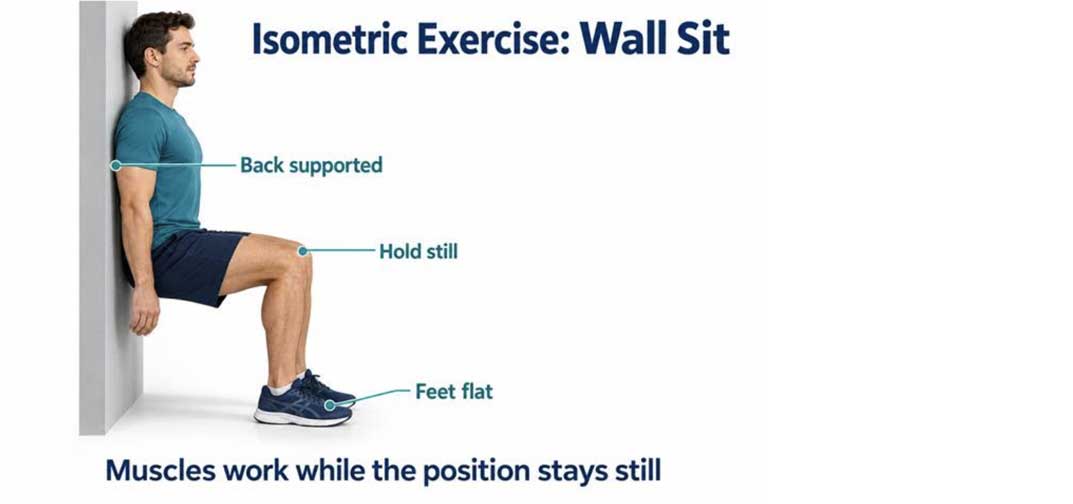
What makes it isometric?
The muscles generate force while the joint position stays nearly unchanged. Holding a wall sit is isometric; repeatedly rising and lowering is dynamic exercise. Other examples include a plank or a sustained handgrip or a quad set.
What does the evidence show?
A 2023 meta-analysis included 270 exercise trials with 15,827 participants. Isometric training reduced resting systolic/diastolic blood pressure by about 8.2/4.0 mmHg versus non-exercise controls in pooled analyses. These are group averages across isometric studies, not a guaranteed result or an immediate effect of one wall sit. Aerobic and dynamic resistance exercise also helped. [1]
Teaching the wall sit
Support the back against a wall, place feet flat and keep knees aligned over ankles. Hold a comfortable position without bouncing. The image shows a deeper hold; use a shallower bend when needed. Breathe normally throughout. Tailor depth, effort, hold duration and rest to the individual. I personally need to keep my knees 30-40 degrees bent or I develop knee pain.
Clinical safety
Blood pressure can rise during a sustained contraction, especially with hard effort or breath-holding. People with hypertension or cardiovascular disease should obtain clinician guidance before starting. Stop for chest pain, dizziness or unusual breathlessness. Exercise complements prescribed medication and other activities; it does not replace them. [2]
Check your understanding
Why can an exercise that raises blood pressure during a hold still reduce resting blood pressure after regular training? Distinguish the acute response from the longer-term training effect.
Sources
[1] Edwards JJ et al. Br J Sports Med. 2023;57:1317-1326. doi:10.1136/bjsports-2022-106503.
[2] Mayo Clinic. Isometric exercises: Good for strength training? (Nov. 18, 2023).
Educational illustration; exercise selection and dosage require individual assessment.