


A Case Study of a Baby Toe Bump
-

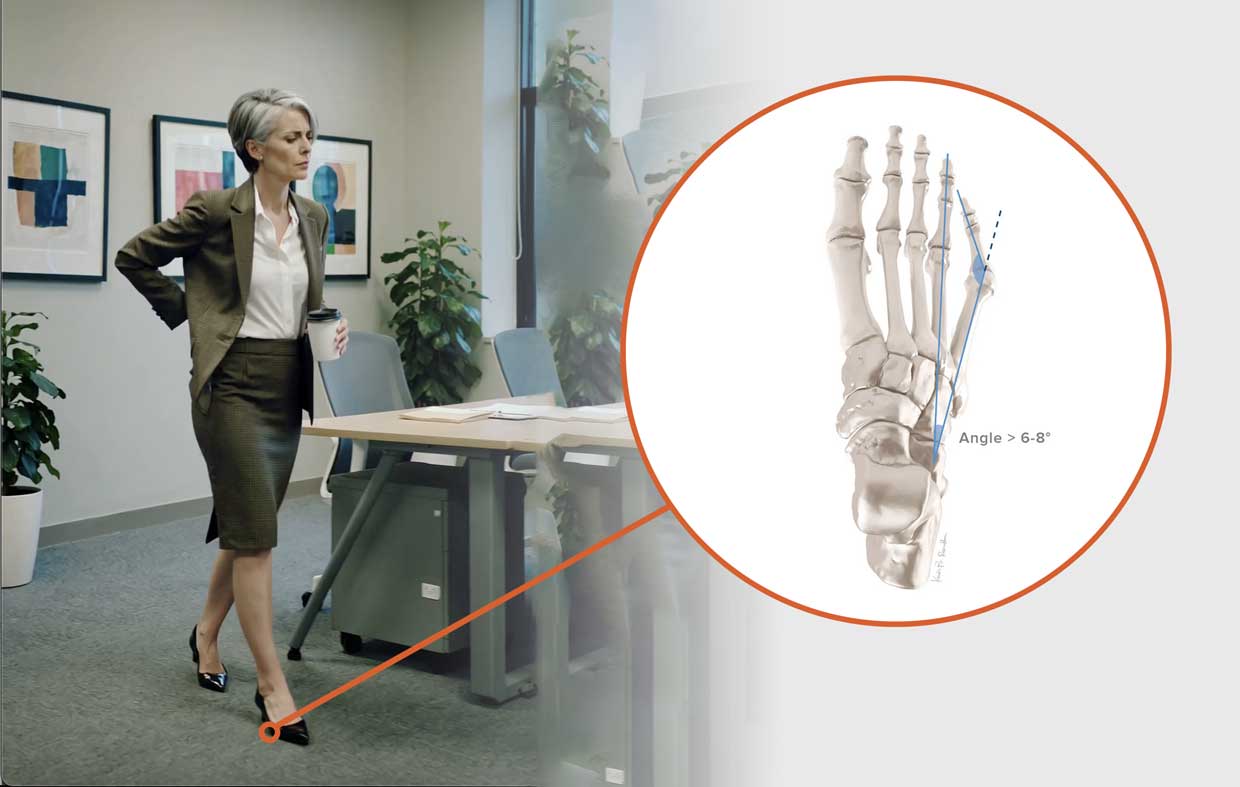
Ms. SB is a 59 year old female who presents with a chief complaint of a painful enlargement on the outside of both feet with the right slightly worse than the left, which has been present for many years, but has recently progressed and become red, swollen and warm to touch. Her occupation as an office manager requires her to wear professional attire, including women’s dress shoes which exacerbate the condition. She claims to have wide feet, and has always had difficulty finding shoes that fit her properly and are comfortable, yet stylish and attractive. She can tolerate certain open toe dress shoes, but that is frowned upon in her office. During her leisure activities and personal time she wears athletic type shoes, but those have become uncomfortable recently as well. She has tried over the counter bunion pads and topical pain relievers with little success in improving the condition. She was told by a friend that she has a “Tailor’s Bunion” and she would probably have to have it surgically corrected, but she is very frightened of surgery and would like to seek alternative treatments if possible.
The patient is 5’5” tall and weighs 130 pounds. She reports overall good health, with a history of mild hypertension controlled by medication and takes HRT for post menopausal symptoms. She denies smoking, recreational drug use and has an occasional alcoholic beverage socially.
Lower extremity physical exam findings include ¾+ pedal pulses bilaterally and instantaneous capillary return in all digits, with all digits warm to touch. Neurological exam findings are non-contributory, and dermatological exam reveal no unusual lesions or masses, skin tone and temperature is within normal limits, hair and nail growth is also within normal limits. Musculoskeletal exam findings including absence of limb length discrepancy, normal range of motion of hips, knees, ankles, subtalar, midtarsal and metatarsal phalangeal joints bilaterally. Muscle strength is WNL in all groups. Gait analysis significant findings include inverted heel strike, slightly delayed heel lift, significant medial arch lowering, abductory twist and mild apropulsion. Musculoskeletal deformities are absent with the exception of the chief complaint, enlargement and prominence of the lateral aspect of the 5th metatarsal head, right greater than left. The right foot deformity shows evidence of significant inflammation with redness, swelling and localized warmth, Palpation of the right deformity reveals soft tissue swelling consistent with bursitis. Weight bearing x-rays of both feet reveal lateral bowing of the 5th metatarsal right greater than left, mild deviation of the 5th metatarsal phalangeal joint, with soft tissue swelling evident laterally over the 5th metatarsal head.
Discussion:
The diagnosis of Tailor’s bunion (bunionette) with digiti quinti varus was established. Surgical correction of the deformity including distal osteotomy of the 5th metatarsal was recommended, but the patient declined in lieu of possible more conservative measures to control symptoms. An injection of corticosteroid and local anesthetic was performed into the inflamed bursa on the right foot and tolerated well by the patient. She returned to the clinic two weeks later and reported significant improvement of the pain and inflammation. The biomechanical etiology and long term control via the use of custom functional foot orthotics was discussed in detail with the patient, and her feet were then scanned and two pairs of orthotics prescribed, one for dress shoes, and the other for casual shoes.
Biomechanical control of Tailor’s Bunion has always been challenging. Careful examination of these feet often reveal varus deformities of the rearfoot and forefoot, as well as hypermobility along the lateral column of the foot, particularly in the Cuboid-5th metatarsal articulation. A fairly rigid frame, and paradoxically, a maintenance of the medial arch and propulsion mechanism of the 1st MTPJ often enhance the ability to control a Tailor’s bunion. The following orthotic modifications can be used to enhance your correction of the baby toe bump.
